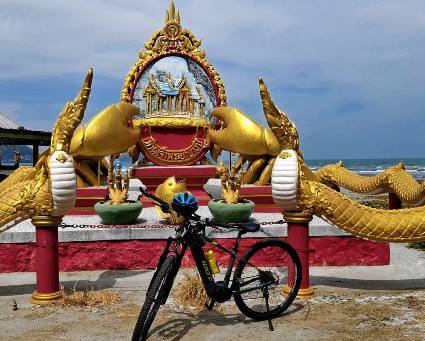
Northern Thailand, the Quiet Way
In Northern Thailand, the backroads seem to hold their own kind of silence. It hangs in the trees above mountain villages, drifts through temple grounds and morning markets, and follows you along the smaller roads where the north reveals itself slowly, through texture, light, and local life.
Many tours between Chiang Mai and Chiang Rai promise mountain scenery and cultural encounters, but this route earns its distinction by going smaller. It prefers backroads to main roads, village life to obvious stops, and a more intimate understanding of the north over a hurried collection of highlights. The eBikes help, not by reducing the journey, but by allowing riders to enjoy the hills, linger in the villages, and notice the details that give this part of Thailand its particular character.
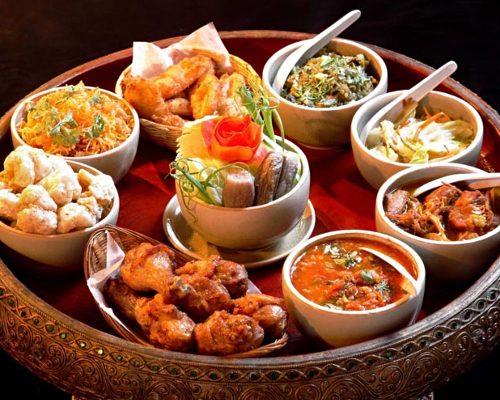
A traditional northern dinner served on a khantoke table!
 Chiang Mai makes a lively beginning, with its old city walls, temple courtyards, and the easy pleasure of a riverside dinner, but the route does not stay urban for long. Soon the road is edging into countryside where handicraft workshops, roadside shrines, and smaller temple complexes begin to replace the city's denser rhythms. Wat Tham Mae On, set within a limestone cave, introduces one of the northern themes that recurs throughout the trip: spirituality shaped by landscape rather than separated from it.
Pang Hai brings a warmer, more local register. A homestay in a mountain village shifts the journey away from tourism and toward hospitality, and that matters. It sets a tone of closeness that remains even when the scenery grows more expansive. This is a tour where local coffee shops in small mountain towns matter as much as famous sites, because they say something true about the present-day north. The beans are often grown nearby, roasted nearby, and brewed by people who know exactly where they came from.
The mountain section through Chae Son National Park offers some of the week's most beautiful riding. Teak and hardwood forest shade the roads, the air cools, and the climb toward Wat Chaloem Phrakiat carries a quiet sense of anticipation. The white stupas high on the ridge seem almost unreal when they first appear, suspended against sky and mountains, but what makes them memorable is the approach. You do not drive up for a viewpoint. You ride into the landscape that gives the temple its meaning.
After that, the route opens again into farmlands, lakeside calm, and smaller towns. Phayao brings a welcome softness after the climbs, with water, open sky, and the slower pace of a provincial center. Markets and roadside eateries continue to shape the days, and the north's food culture becomes part of the journey in a more specific way. Riverside meals, local favorites chosen by the guides, and the steady appearance of dishes that belong to this region alone all reinforce the sense that you are moving through a distinct cultural world.
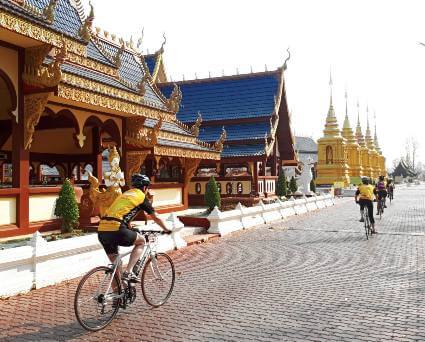
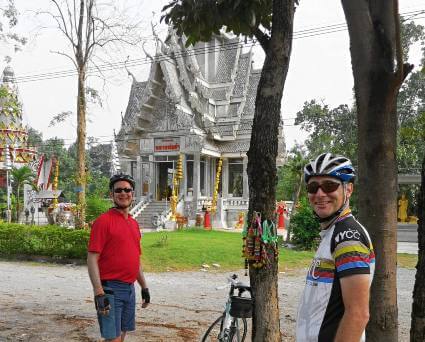
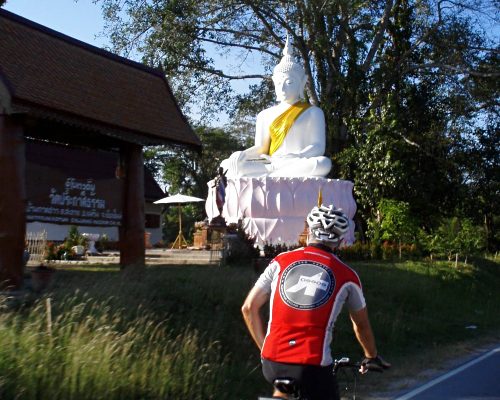
Cycling past small temples in the countryside!
 One of the most appealing features of the tour is its historical depth, especially around Wiang Lo. The ruins there remain far less visited than many comparable sites, which gives the visit a satisfying air of genuine discovery. Exploring by samlor adds a further local dimension, and the day's continuation through Wat Nantaram and the Tai Lue heritage at Wat Phrathat Sob Wean broadens the story beyond scenery into overlapping traditions of architecture, belief, and settlement. Teak temples in Chiang Kham deepen that impression still further.
The final approach toward Chiang Rai carries on through Phu Sang National Park, villages, and market country before the trip closes in the city. By then, the route has already made its strongest case. It is not trying to dazzle with constant spectacle. It is showing Northern Thailand as a lived-in region of mountain communities, temple culture, local food, and roads that still feel genuinely pleasant to ride. That is a quieter ambition, but in many ways a more rewarding one.
For travelers drawn to cycling adventure tours that feel thoughtful, local, and textured rather than over-designed, this one has real charm. It leaves behind the memory of shaded roads, village coffee, white stupas on high ridges, teak temples, and a north that comes into focus gradually but decisively. That sort of understanding tends to last.